
When looking for an art or design school, the question of the working environment arises even before that of the diploma. In Nantes, the workshops are not concentrated in a single university building: they are spread across Île de Nantes, the Quartier de la Création, and several satellite sites, sometimes as far as Saint-Nazaire. This geographical dispersion, far from being a drawback, structures an ecosystem where creative students interact daily with agencies, galleries, and production studios.
Workshops and materials in Nantes: what creative schools provide
A creative curriculum is judged first by what can be made, not by what is learned in a lecture hall. In this regard, Nantes schools offer a technical range that is rarely found in a city of this size.
The Beaux-Arts de Nantes provides access to workshops for wood, metal, glass, ceramics, lithography, screen printing, photography, video, and sound. This is not a theoretical catalog: each workshop corresponds to a physical space equipped and supervised by technicians. For those considering studying design in Nantes, this diversity allows for experimentation with materials before specializing, which changes the trajectory of a diploma project.
Access to both manual and digital techniques distinguishes Nantes from more screen-oriented programs. One can move from a ceramic prototype in the morning to video editing in the afternoon, all on the same campus.
Quartier de la Création on Île de Nantes: a campus integrated into the city
The École de design Nantes Atlantique is located in the heart of the Quartier de la Création, on Île de Nantes. The building itself acts as a signal: contemporary architecture open to the neighborhood, accessible coworking spaces, and immediate proximity to cultural structures and agencies.
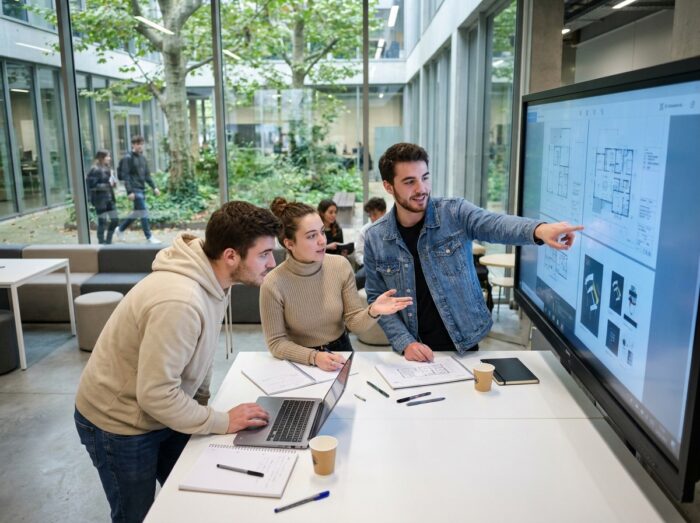
What changes the game for students is the permeability between the campus and the professional fabric. One does not have to cross the city to attend a conference or visit a studio. Training venues and production sites share the same streets, sometimes the same buildings.
The Quartier de la Création concentrates actors from the digital, design, and cultural industries. For a student seeking an internship or first job, this density shortens the journey between the classroom and the first interview.
Exhibitions and professional integration of graduates in Nantes
The transition from student status to that of a young artist or designer often hinges on visibility. Nantes has structured initiatives that facilitate this transition, beyond just an alumni network.
In October 2025, the exhibition “Don’t stop me now” showcased 34 graduates from the Beaux-Arts in the school and in two Nantes galleries, as part of Wave 2025. The principle: to associate school, galleries, and public visibility right from graduation. This type of initiative does not exist everywhere. It transforms a final project into a first professional exhibition, with an audience, potential collectors, and local media coverage.
On the design side, the École de design Nantes Atlantique hosted the international conference Cumulus 2025, from June 3 to 7, 2025. This event brings together design schools from around the world. For the attending students, it is a concrete opportunity to confront their projects with international perspectives and to make contacts outside of France.
Student housing in Nantes: choose based on the campus, not the city center
It is often said that Nantes is an affordable city for students. This is generally true compared to Paris or Lyon, but the choice of housing deserves more precision than a simple comparison of average rents.
The right reflex is to choose your neighborhood based on the exact campus, not the city center. Creative institutions in Nantes are spread across several sites. An apartment well-located for Île de Nantes may become impractical if part of the curriculum takes place in Saint-Nazaire or La Roche-sur-Yon.
Here are a few concrete criteria to check before signing a lease:
- The actual distance by transport between the accommodation and the campus or campuses where classes, including workshops, take place
- The tramway or busway service, which conditions daily commutes much more than the straight-line distance
- The proximity to the Quartier de la Création if the curriculum involves frequent trips with partners or galleries
Feedback varies on this point, but several design students report that neighborhoods close to Île de Nantes (Malakoff-Saint-Donatien, Dervallières-Zola) offer a good compromise between budget and accessibility.
Cultural life and the Nantes artistic network: beyond the campus
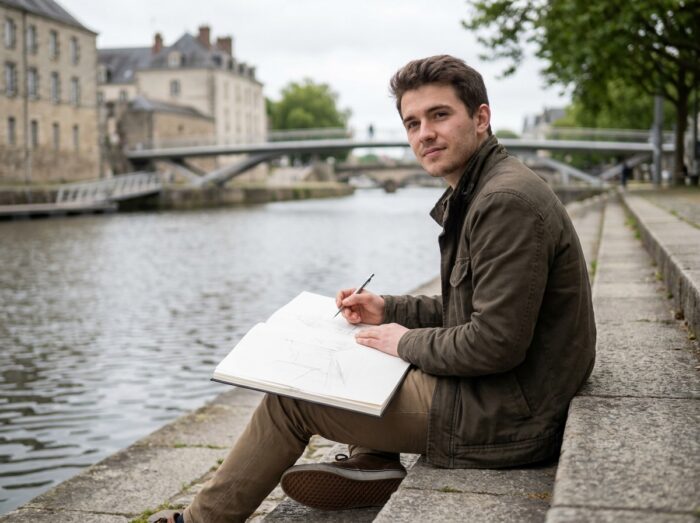
Nantes is not a city where culture is confined to the walls of the school. The metropolis regularly hosts events that directly enrich creative pathways: exhibitions, festivals, artist residencies.
For a student in art or design, this cultural density serves two functions:
- It nourishes personal research by exposing students to varied practices (installations, live performances, urban design)
- It creates opportunities for informal professional encounters, outside the school framework
- It allows for testing projects in public spaces, which few cities of comparable size facilitate as much
The French Tech label of the metropolis also strengthens the digital ecosystem. Students working on projects that blend digital design and artistic creation find in Nantes a landscape where bridges between tech and culture already exist, supported by structures located in the Quartier de la Création.
Nearly a third of the Nantes population is under 30 years old. This proportion generates an associative and cultural life focused on young creatives, with dissemination spaces, collectives, and shared workshops accessible without waiting for the end of their studies. Nantes offers a creative ecosystem where training and professional practice overlap, which shortens the time between the end of studies and the first independent projects.