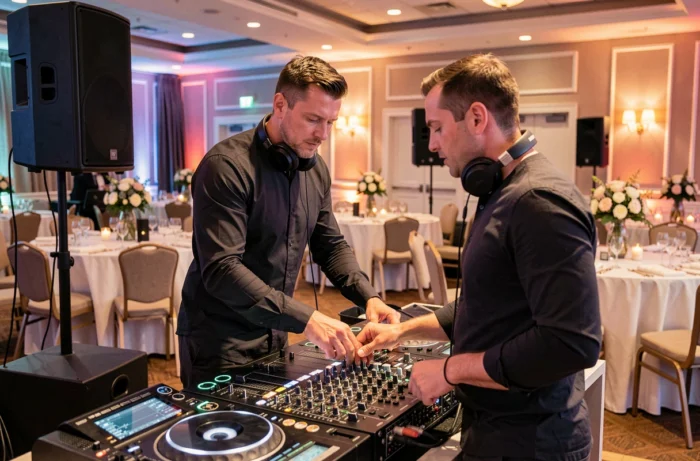
A wedding where nobody dances is often a sound distribution problem. The music is too loud near the tables and too quiet on the dance floor, so guests stay seated. Choosing a wedding sound system suited to the venue and guest count can completely transform the atmosphere of the evening. The real challenge isn’t raw power, but how the sound reaches every guest’s ears, from the front row to the back of the room.
Sound coverage and speaker placement: what power alone can’t fix
Have you ever noticed how, in some venues, the music sounds muffled ten metres from a speaker but deafening right in front of it? This imbalance is rarely caused by a lack of watts. It’s usually down to poor placement.
Speakers raised off the ground and aimed towards the back of the room provide better coverage than a single powerful speaker turned all the way up. Set them on stands at around 1.80 m high and angle them slightly downwards. This projects the sound over the front rows instead of blasting them. The result: guests near the dance floor can enjoy the music without making the nearby tables unbearable.
Before the guests arrive, walk around the entire room while the music is playing. Look for areas where it’s too loud and pockets of silence. Move a speaker a few metres, adjust its angle, and the problem will often disappear without changing the volume. To choose a wedding sound system that really works, this coverage test is more valuable than a power calculation on paper.
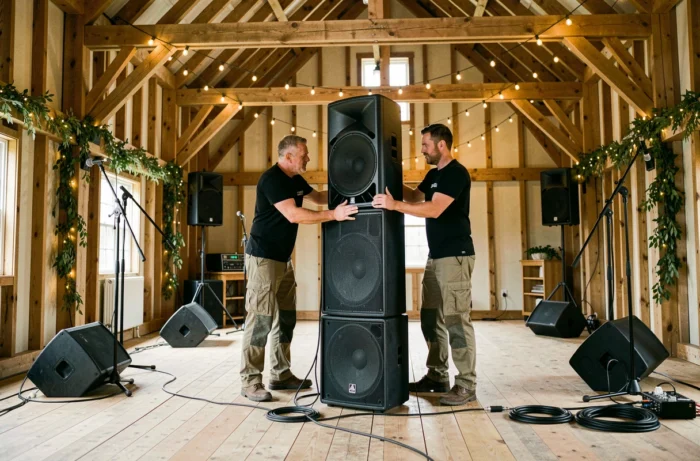
Wedding sound systems and noise from neighbours: what the rules say about noise emergence
Many couples assume there’s a decibel limit they must not exceed. The regulations are more nuanced than that.
Article R. 1336-6 of the French Public Health Code does not set a maximum volume. Instead, it is based on the concept of noise emergence: the difference between the noise level measured while the music is playing and the venue’s usual residual noise level. Article R. 1336-7, in force since 10 August 2017, sets the reference thresholds at 5 dB(A) during the day and 3 dB(A) at night, with an adjustment based on how long the noise lasts.
In practice, a venue in a quiet rural area can tolerate less volume than one in a city centre, where ambient noise is already higher. The issue isn’t your sound system itself, but the difference it creates compared with the neighbours’ usual quiet.
Reduce noise emergence without killing the atmosphere
Aiming the speakers into the room (rather than towards open windows or doors) reduces the amount of sound travelling outside. Closing the windows facing the neighbours during the dancing is a simple step that may be enough. For an outdoor reception, placing the speakers with their backs to the wind also limits how far the sound carries.
Ask the supplier or rental company how they plan to cover the room, not just how much power they’re bringing. A good supplier talks about speaker direction and coverage zones, not just watts.
Sound by zone: the ceremony, cocktail hour and evening reception each need different equipment
A wedding unfolds in several stages, often in different spaces. Using a single sound system in the same spot all day means settling for a poor compromise at every stage.
- The ceremony (civil or religious) calls for gentle, clear sound. A compact battery-powered speaker with a wireless microphone is enough. The goal is for every word of the vows to be heard in the back row, without excessive reverberation.
- Cocktail hour or the drinks reception calls for light background music. Two small speakers spaced several metres apart create an even sound without needing to turn up the volume.
- The evening reception calls for power and bass. This is where higher-capacity powered speakers come in, along with a subwoofer, depending on the number of guests, to give the dance floor some impact.
Planning for equipment moves, power supply and microphone checks in each space is part of the brief. An outdoor ceremony with no power outlet requires a self-powered speaker. Overlook this detail, and the first ten minutes of the wedding could be ruined.
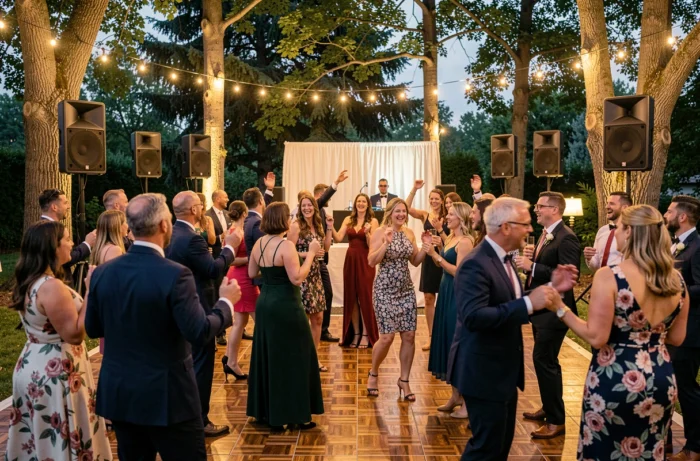
Active or passive speakers, renting or buying: choices that affect your wedding sound system budget
For a wedding, active speakers (with a built-in amplifier) make everything simpler. There’s no external amplifier to transport, fewer cables and a quick setup. They’re the most common choice for both rentals and one-off purchases.
Passive speakers, which need a separate amplifier, offer more flexibility for complex setups. But for most weddings with fewer than 150 guests, they add complexity without any audible benefit.
Renting or buying: the real cost
Renting a complete sound system package (speakers, stands, wireless microphone and cables) costs a fraction of the purchase price. If you don’t have another use for it, renting is still the most sensible choice for a one-off event. Rental packages often include recent, tested equipment.
Buying makes sense if you regularly host parties or if a DJ friend or relative already owns some of the equipment. In that case, focus your budget on good powered speakers and a reliable wireless microphone for speeches.
Keeping equipment safe during the celebration
Cables in walkways should be protected with cable covers or secured to the floor. Speaker stands must never block an emergency exit or obstruct the flow of guests. This point, rarely covered in guides, is as much about safety as it is about comfort.
The perfect sound system for a wedding isn’t the one with the highest power rating. It’s the one that provides even coverage throughout the room, adapts to every part of the day and respects the comfort of both guests and neighbours. Test the sound in the actual venue, not just by reading a spec sheet.